|
Who's shining and who's hiding this spring — plus Caitra Śukla Pratipadā and the art of equanimity. ͏ ͏ ͏ ͏ ͏ ͏ ͏ ͏ ͏ ͏ ͏ ͏ ͏ ͏ ͏ ͏ ͏ ͏ ͏ ͏ ͏ ͏ ͏ ͏ ͏ ͏ ͏ ͏ ͏ ͏ ͏ ͏ ͏ ͏ ͏ ͏ ͏ ͏ ͏ ͏ ͏ ͏ ͏ ͏ ͏ ͏ ͏ ͏ ͏ ͏ ͏ ͏ ͏ ͏ ͏ ͏ ͏ ͏ ͏ ͏ ͏ ͏ ͏ ͏ ͏ ͏ ͏ ͏ ͏ ͏ ͏ ͏ ͏ ͏ ͏ ͏ ͏ ͏ ͏ ͏ ͏ ͏ ͏ ͏ ͏ ͏ ͏ ͏ ͏ ͏ ͏ ͏ ͏ ͏ ͏ ͏ ͏ ͏ ͏ ͏ ͏ ͏ ͏ ͏ ͏ ͏ ͏ ͏ ͏ ͏ ͏ ͏ ͏ ͏ ͏ ͏ ͏ ͏ ͏ ͏ ͏ ͏ ͏ ͏ ͏ ͏ ͏ ͏ ͏ ͏ ͏ ͏ ͏ ͏ ͏ ͏ ͏ ͏ ͏ ͏ ͏ ͏ ͏ ͏ ͏ ͏ ͏ ͏ ͏ ͏ ͏ ͏ ͏ ͏ ͏ ͏ ͏ ͏ ͏ ͏ ͏ ͏ ͏ ͏ ͏ ͏ ͏ ͏ ͏ ͏ ͏ ͏ ͏ ͏ ͏ ͏ ͏ ͏ ͏ ͏ ͏ ͏ ͏ ͏ ͏ ͏ ͏ ͏ ͏ ͏ ͏ ͏ ͏ ͏ ͏ ͏ ͏ ͏ ͏ ͏ ͏ ͏ ͏ ͏ ͏ ͏ ͏ ͏ ͏ ͏ ͏ ͏ ͏ ͏ ͏ ͏ ͏ ͏ ͏ ͏ ͏ ͏ ͏ ͏ ͏ ͏ ͏ ͏ ͏ ͏ ͏ ͏ ͏ ͏ ͏ ͏ ͏ ͏ ͏ ͏ ͏ ͏ ͏ ͏ ͏ ͏ ͏ ͏ ͏ ͏ ͏ ͏ ͏ ͏ ͏
“Oh, what a catastrophe for man when he cut himself off from the rhythm of the year, from his unison with the sun and the earth … cut off from the magic connection of the solstice and the equinox!”D.H. Lawrence
|
Looking UpWho's Shining and Who's Hiding This Spring
|
|
|
Venus and Jupiter sharing the twilight sky. November 26, 2019.
Image Credit & Copyright: Juan Carlos Casado (TWAN) |
|
|
The days are getting longer. Step outside at sunset, face west, and wait. As twilight deepens, Venus appears — the brightest object in the sky after the Moon. Venus will remain the "evening star" until October. Most strikingly, it will approach Jupiter for a conjunction (yuddha) on June 9th: two bright benefics side by side, a gorgeous sight. Jupiter is the other easy find right now, brilliant in the evening sky near the twins Castor and Pollux in Gemini. Freshly stationed direct after months of retrograde, it is picking up speed. On June 1st Jupiter enters Cancer, its rāśi (constellation) of exaltation, where Jupiter is said to be at its most expansive and beneficent. (Have you had a chance to explore what this auspicious transit potentiates for you, based on the ecosystem of your birth chart?) Now for what you won't see. Mars has been invisible since late 2025 and won't return to our skies until well into this summer. On paper, Mars sits well outside the combustion range delineated by the tradition, the zone around the Sun within which a planet is considered invisible and therefore weakened. So why can't we see it? Because Mars is also on the far side of its orbit, at its greatest distance from Earth, intrinsically faint. Add atmospheric extinction near the horizon (the dimming of light as it passes through thicker layers of atmosphere) and the Sun's residual glare, and those degrees of separation aren't enough. The chart says "visible"; the sky says "gone." This is why we look up. In Jyotiṣa, and in every ancient sky-watching tradition, when a planet disappears from view, it isn't simply absent. Its energies become destabilized: erratic, harder to access, less regulated. The planet that every civilization on Earth associates with conflict and martial force has been invisible for many, many months. Look around. Saturn, too, is disappearing into the Sun's glare, entering combustion. But at the very center of every combustion there is a moment of cazimi, a Latinized Arabic term for when a planet sits in the exact "heart" of the Sun. On March 25th, for roughly eleven hours, Saturn reaches that point, and proximity flips from obscurity to empowerment — the planet, instead of being burned by the king's light, is ushered into the throne room and seated beside the sovereign. Saturn will slowly re-emerge on the pre-dawn eastern horizon in late April/early May, faint and low at first. And Mercury? True to form, one brief, elusive appearance in the morning sky in late March through early April. Blink and you'll miss it. One date for your calendar: on April 19th, Mars transits the same Pisces degree as Saturn while Mercury is also in the same tight range, a potent planetary war (conjunction) to note, even if difficult to view. May your skies be clear and your horizons unobstructed! Note: Visibility depends on your latitude, elevation, and local conditions. Dates are approximate; consult a planetarium app or your local pañcāṅga for precise timings in your area.
|
Caitra Śukla Pratipadā:
A Collective New Beginning
|
|
|
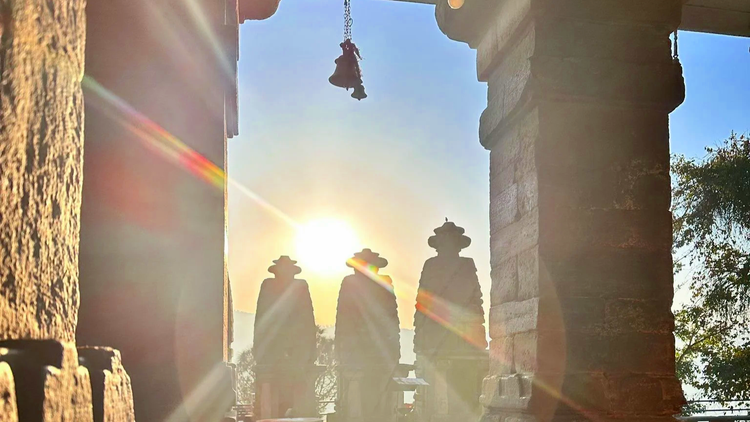
The beginning of a new cycle. Sun temple at Katarmal, Uttarakhand.
Photo: Claudia Anfuso |
|
|
With the steady turning of India’s unique soli‑lunar calendar, the highly auspicious Caitra Śukla Pratipadā arrived once again like a quiet dawn this year on 19th March. Celebrated across many regions of India as the beginning of the new year, this sacred threshold comes with the Spring season (Vasanta ṛtu), as Mother Earth turns toward warmth and light. Colour returns to the world, the days begin to lengthen, the first warm breezes of the year are felt, and Nature gently invites life in all its variety to awaken with renewed spirit. Caitra Śukla Pratipadā encourages communities to pause from the usual routines, leave the past in the past and, invoking Divine grace, step into the coming year refreshed and inwardly renewed. Whether observed as Guḍī Paḍwā, Yugādi, Ceti Cand, or by other regional names, the essence of this new year festival remains the same: a shared cultural celebration welcoming new, life‑affirming cycles of growth and forward movement. This date also marks the beginning of this year’s Caitra Navarātri, a splendid nine‑day (and night!) festival dedicated to Śakti, the Divine Feminine. With spring unfolding around it, this particular Navarātri carries a natural sense of blossoming – an invitation to harmonise our life’s rhythms with the season’s renewal. Homes and temples come alive with devotion as the Goddess is invoked, symbolising the start of a spiritual journey toward purification, strength, virtue and wisdom. The many forms of the Divine Mother are worshipped, and the festival culminates on the ninth day with Śrī Rāma Navamī, honouring the birth of Lord Rāma, the embodiment of Dharma. For India’s astrologers, Caitra Śukla Pratipadā holds a special significance. It is on this day that the Varṣa Kuṇḍalī, or annual horoscope, is cast. Prepared for the precise moment of the Sun-Moon conjunction in sidereal Pisces that inaugurates the new year, this chart offers insights into the collective experiences society may encounter in the months ahead. Through it, astrologers understand the emerging themes, societal moods, and the subtle currents that may shape the year’s unfolding. Caitra Śukla Pratipadā reminds us that whatever may be happening around us, Nature always offers us a chance to begin anew. Indian tradition weaves cultural celebration, spiritual renewal, and cosmic perspective into this single, hopeful threshold – one that invites us to enter the new year with steadiness, wisdom, and grace. We wish all our readers a very happy Caitra Śukla Pratipadā! May the coming year bring auspiciousness for all beings.
|
|
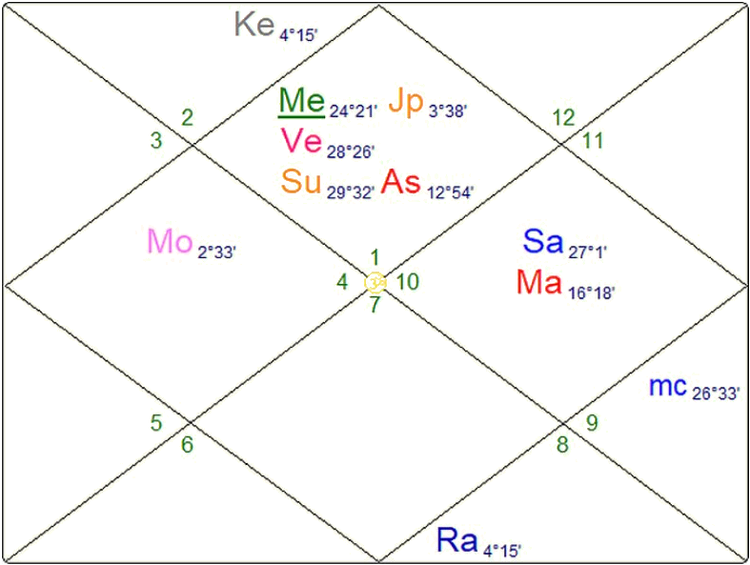
When the Sun crosses the celestial equator, day and night are said to be in perfect balance. From the same Latin root, aequus, we also get the word equanimity. Equanimity is a laudable quality of mind, one that remains level even when chaos abounds. It’s a kind of internal equilibrium (yet another cognate) that holds steady through the inevitable ups and downs of life. What might be the chart markers of equanimity? One might immediately think in terms of the great benefics in the chart—Jupiter and Venus. We call them benefics because they are the brightest among the heavenly bodies after the Sun and Moon but also because they are the two grahas who spend most of their astronomical cycle moving with a steady gait (sama gati) rather than speeding up, slowing down, going retrograde etc. It gets even better when these benefics have no affliction. In addition, if the grahas are in positive bhāvas rather than in the bhāvas that have a predominance of challenging themes, that is also a big plus. So let’s examine a chart where such conditions exist and see if maintaining equanimity would be an accurate description of the individual. Below is the chart of Gabriel Faure, the renowned composer, Born 5/12/1845 at 4 AM in Pamiers France.
|
|
Faure has all of his sapta grahas (the seven grahas that are either planets or luminaries) in the positive bhāvas. It is an amazing chart as all except Venus are strong, some in more than one way. All the benefics are in the lagna and the lagna lord is a powerhouse. Clearly there is also affliction especially to the Moon but again, we are investigating equanimity in the face of adversity as well as in good times. Aaron Copland, an American composer remarked that Faure’s life and work had “all the earmarks of the French temperament: sensibility, impeccable manners and classic reserve. Faure even was quoted as saying that death was “a happy deliverance, an aspiration towards happiness above rather than a painful experience”. Faure’s music was characterized from the start by an innate sense of balance and beauty reflecting an inner life and creative output that matched each other across his life. This pointed to something that was structured in him rather than being merely cultivated. Even as a critic of other colleague’s music, he couldn’t be unkind. He was naturally generous. However, the real test comes when life deals its inevitable blows. For a space in his life he was heartsick over a broken engagement and left Paris for a long journey. And, more devastating was his hearing loss. Like Beethoven, he became completely deaf. But while Beethoven’s hearing loss famously darkened him, Faure felt he was able to devote himself to composition for the first time and produced extraordinary music in that literal silence. Far from being untouched by life, he was deeply touched but had the capacity to center himself. He was not embittered as he was able to return to the still point within the noise of life.
|
Learn to read the sky!New basics classes — June 2026. Join us.
|
|
|
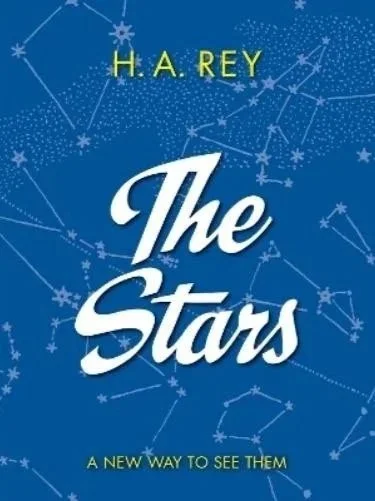
Ever looked up at the night sky and wished you understood more of what you were seeing? This is the book for you. H.A. Rey — best known as the creator of the beloved children's classic Curious George — wrote a genuinely delightful, accessible, and thorough primer on stargazing (and spherical astronomy). The Stars: A New Way to See Them will help you orient to the cosmos and find your place in the universe. The perfect companion for the stargazing months ahead — and a treasure for any student of Jyotiṣa! (Hat tip to Judy Quinby for pointing us skyward with this one!) |
|
|
|
|
|