|
Jupiter's exalted transit, the sky's summer story, and a paragon of dharma. ͏ ͏ ͏ ͏ ͏ ͏ ͏ ͏ ͏ ͏ ͏ ͏ ͏ ͏ ͏ ͏ ͏ ͏ ͏ ͏ ͏ ͏ ͏ ͏ ͏ ͏ ͏ ͏ ͏ ͏ ͏ ͏ ͏ ͏ ͏ ͏ ͏ ͏ ͏ ͏ ͏ ͏ ͏ ͏ ͏ ͏ ͏ ͏ ͏ ͏ ͏ ͏ ͏ ͏ ͏ ͏ ͏ ͏ ͏ ͏ ͏ ͏ ͏ ͏ ͏ ͏ ͏ ͏ ͏ ͏ ͏ ͏ ͏ ͏ ͏ ͏ ͏ ͏ ͏ ͏ ͏ ͏ ͏ ͏ ͏ ͏ ͏ ͏ ͏ ͏ ͏ ͏ ͏ ͏ ͏ ͏ ͏ ͏ ͏ ͏ ͏ ͏ ͏ ͏ ͏ ͏ ͏ ͏ ͏ ͏ ͏ ͏ ͏ ͏ ͏ ͏ ͏ ͏ ͏ ͏ ͏ ͏ ͏ ͏ ͏ ͏ ͏ ͏ ͏ ͏ ͏ ͏ ͏ ͏ ͏ ͏ ͏ ͏ ͏ ͏ ͏ ͏ ͏ ͏ ͏ ͏ ͏ ͏ ͏ ͏ ͏ ͏ ͏ ͏ ͏ ͏ ͏ ͏ ͏ ͏ ͏ ͏ ͏ ͏ ͏ ͏ ͏ ͏ ͏ ͏ ͏ ͏ ͏ ͏ ͏ ͏ ͏ ͏ ͏ ͏ ͏ ͏ ͏ ͏ ͏ ͏ ͏ ͏ ͏ ͏ ͏ ͏ ͏ ͏ ͏ ͏ ͏ ͏ ͏ ͏ ͏ ͏ ͏ ͏ ͏ ͏ ͏ ͏ ͏ ͏ ͏ ͏ ͏ ͏ ͏ ͏ ͏ ͏ ͏ ͏ ͏ ͏ ͏ ͏ ͏ ͏ ͏ ͏ ͏ ͏ ͏ ͏ ͏ ͏ ͏ ͏ ͏ ͏ ͏ ͏ ͏ ͏ ͏ ͏ ͏ ͏ ͏ ͏ ͏ ͏ ͏ ͏ ͏ ͏ ͏
We do sādhana so that the planets can talk to us.— Mantriji
|
The Blessings of Exalted JupiterSalutations to the benevolent Devaguru Bṛhaspati, the Exalted, Venerable Guru of the Gods!
|
|
The śāstras tell us that wherever Devaguru goes, he raises his hand in blessing, bestowing abundance, wisdom, and auspiciousness. For twelve years Guru has traversed the zodiac, and now, ascending to his place of exaltation, he once again reveals the full splendour of wisdom, dharma and grace. This long cycle reminds us that wisdom and fulfilment are not gained easily – they are earned through purity of heart, sincerity of intention, and steadfast devotion. When Jupiter stands strong, the gateways of grace open widely, and we are invited to move towards greater virtue, compassion, and the inner peace born of true wisdom.
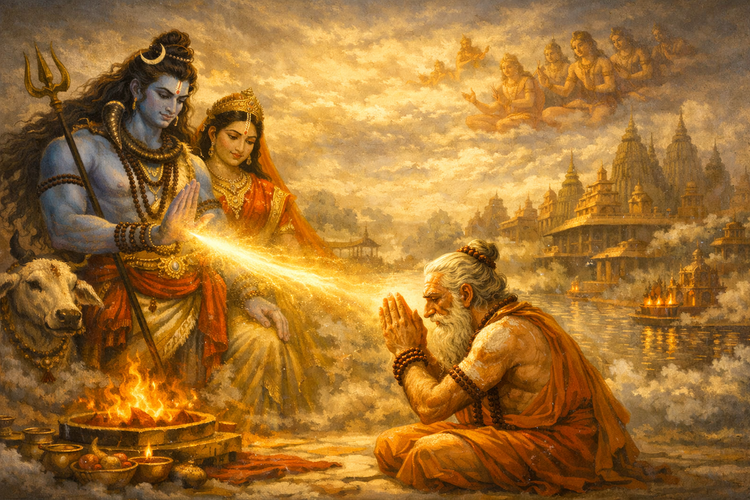
The Indian tradition preserves a beautiful account of how Bṛhaspati attained the status of a graha — one of the nine revered ‘graspers’ who dispense to mortal beings the fruits of their actions. Once upon a time, the Sage performed intense tapas in the sacred city of Kāśī, immersing himself in deep meditation with unwavering discipline and a pure heart. So pure was his devoted practice that Lord Śiva Himself appeared before him, offering a boon. Bṛhaspati could have asked for anything – sovereignty, wealth, or celestial dominion – but he did not. Instead, he humbly and with great reverence praised the Lord with a hymn and fell silent – a silence born of humility, sincere devotion, and inner fullness. Pleased by this, Lord Śiva bestowed upon him the dignity of a graha and established him as Devaguru, Guru to the Gods. Bṛhaspati’s elevated status arose not from ambition, but the radiant purity and depth of his character.
|
|
|
|
Lord Śiva grants Bṛhaspati the status of Devaguru, the Guru of the Gods. |
|
|
Another episode, narrated in the Bhāgavata Purāṇa (6th skandha), reminds us of the vital importance of honouring the Jupiter principle in our lives. Once, Indra, king of the devas, was intoxicated by victory and the praises of the celestials. At that moment, Bṛhaspati entered the assembly. But overcome by pride and arrogance, Indra failed even to acknowledge – let alone offer the proper courtesies of respect to – his Guru, ignoring Bṛhaspati’s presence entirely. Disrespected by this lapse in humility, Bṛhaspati withdrew from the heavens. Bereft of their Guru, the devas lost their brilliance, fortune, and strength. In the vacuum created by Indra’s arrogance, the asuras rose to power and defeated the devas. A chain of events unfolded that culminated in the rise of the mighty Vṛtrasura – but we’ll save that story for another occasion! In time, Indra recognised his error, sought forgiveness, and restored honour to his Guru, whereupon balance returned to the cosmos. Through this story, we learn that even the most powerful fall when the Guru principle is dishonoured; even the gods cannot flourish without wisdom, humility and dharma.
Together, these stories illuminate the essential nature of Jupiter: Bṛhaspati’s rise was not a conquest but a blessing – a recognition of his calm mind, sweet speech, self‑control, and unwavering commitment to the welfare of all beings. His withdrawal, too, was a teaching: that living beings – even the gods – cannot flourish and thrive when gratitude, humility and dharma are absent.
As Bṛhaspati now shines in his ucca‑rāśi, may we strive to embody his qualities. May we cultivate wisdom through sacred study and introspection; act with virtue even when unseen; speak with kindness; forgive readily; and trust that blessings flow abundantly when the heart is pure. May this exalted transit bring expansion of jñāna (wisdom), dharma, and māṅgalya (auspiciousness) for all beings. And may Devaguru’s gentle, golden light illuminate our paths, guiding us toward choices that nourish our own lives and uphold the harmony of the world.
|
Looking UpAll Eyes on Jupiter, and More
|
|
|
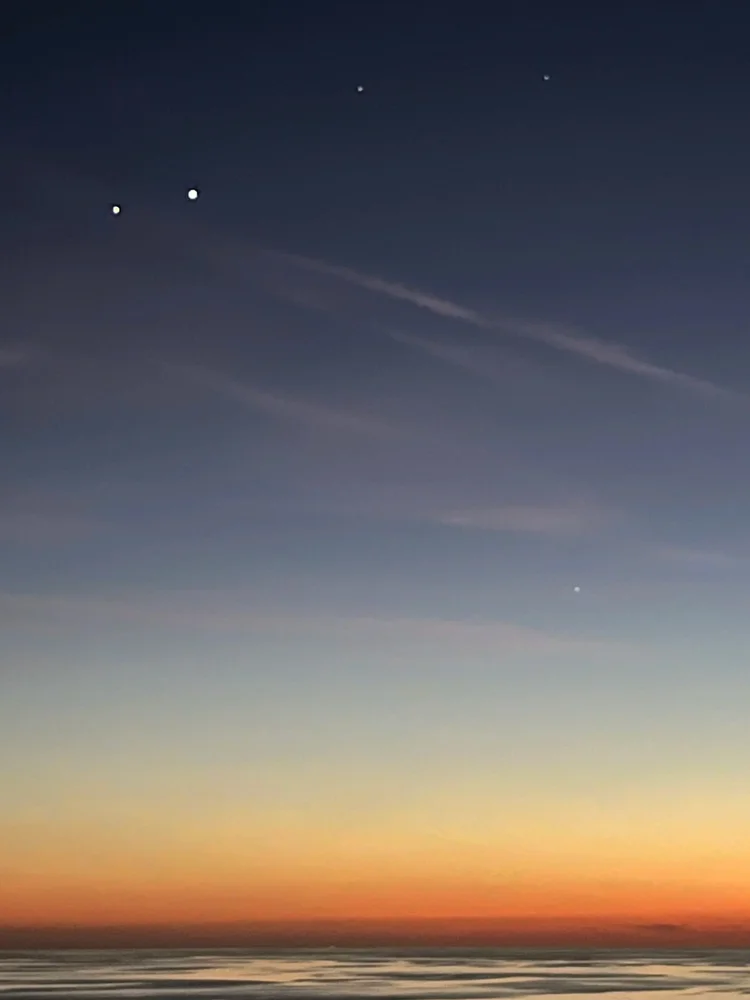
Jupiter and Venus dance, the Twins Castor and Pollux look on, and Mercury makes an appearance (June 8, 2026). Photo: Claudia Anfuso |
|
|
At sunset throughout June, the western sky offers a precious darśan (sight): Venus and Jupiter, the two great natural benefics, gracefully setting in succession. Find an unobstructed western horizon to take it all in. Jupiter's story this season is the most layered. Its Cancer transit unfolds in three parts, and the first is already behind us: a brief entry last October 18th, followed by a retrograde turn before clearing the first degree, and a slip back into Gemini by December 5th. This was anuvakra gati (gait): a graha enters a rāśi (constellation) while moving direct, turns retrograde early in the new rāśi, retreats back into the late degrees of the previous one, only to station direct again and cross the same boundary for the third time. During this kind of extended transitioning (rāśi sandhi), a graha is unsettled and doesn't have time to find solid footing. The second part began on June 1st, when Jupiter re-entered Cancer, its rāśi of exaltation, for a five-month transit. Throughout this passage, Jupiter’s movement is cara gati, significantly faster than its average pace of roughly 5 arcminutes per day. Speed has its advantages, but great speed can also lead to instability. What this transit potentiates and activates is particular to each chart, best met with care and engaged with awareness. Watch Jupiter while you can. Depending on your latitude, it will disappear from visibility around mid-July. By late July it reaches peak velocity as it approaches conjunction with the Sun, and on the 29th Jupiter is at cazimi, hitting the exact heart of the Sun. It will reappear around mid-August, low on the eastern horizon before dawn. Periods of Jupiter's combustion (i.e. invisibility) are traditionally considered inauspicious for undertaking or initiating new endeavors. Consolidate rather than initiate. Jupiter moves next into Leo on October 31st, but it'll be back with one more powerful vakra (retrograde) transit into Cancer in 2027. Now: Mars. In the spring newsletter we noted its prolonged invisibility, months and months obscured by the Sun's glare. That is now ending. Depending on your latitude, Mars has already emerged or is about to emerge from combustion. Look east before sunrise. Mars will appear faint at first, low on the horizon, and brighten over the weeks. Its return, after so prolonged an absence, is worth looking up for. Saturn has been climbing the pre-dawn eastern sky since spring. By midsummer it is impossible to miss, reaching opposition from the Sun on October 4th: rising at sunset, visible all night, as bright as Saturn gets. Venus owns the western horizon after sunset all summer long, growing measurably brighter week by week, before stationing retrograde on October 3rd. Mercury reaches its inferior conjunction with the Sun (positioned between Earth and the Sun) on July 12th, transitioning from evening to morning "star." Its windows of visibility are brief: the evening window of visibility is nearly over, and a fleeting morning apparition follows in early August before Mercury disappears into combustion again as it approaches the August 27th superior conjunction. A few weeks of visibility at best. You know Mercury, blink and it's gone. May your skies be clear and your horizons unobstructed! Note: Visibility depends on your latitude, elevation, and local conditions. Dates are approximate; consult a planetarium app or your local pañcāṅga for precise timings in your area.
|
A Paragon of DharmaThe Chart of Walter Annenberg
|
|
Walter Annenberg was a media mogul, diplomat, and philanthropist who left a lasting mark on 20th-century America. He founded TV Guide, owned major newspapers and magazines, and served as U.S. Ambassador to the United Kingdom under President Nixon. What truly distinguished him, however, was his extraordinary generosity — he donated over two billion dollars to education, the arts, and public media, funding schools, museums, and institutions that still bear his name today. He believed wealth carried a responsibility to give back, and he lived that conviction on a remarkable scale.
|
|
Fittingly, the sky this solstice honors that generosity. The great benefics Jupiter and Venus are in Puṣya nakṣatra. And remarkably, in Annenberg's chart, his rising nakṣatra, Jupiter, and Moon are all in Puṣya, a cosmic celebration of a very generous man, as Puṣya nakṣatra’s symbol is the udder of a cow that lets down its milk for all creatures.
Jupiter is not only in the lagna, it has three-fold strength as it is exalted, retrograde and dig bala. Among the many yogas in the chart, we find this powerful Jupiter is featured in most of them. There is the familiar Hamsa yoga and also the beautiful rāja yoga of the 1st and 9th lords together in a positive bhāva. The Moon elevates this yoga by lagna lord in its own bhāva.
There are some lesser-known yogas Jupiter makes as well. When the Moon is sva or exalted in a kendra or trikona, and in sambandha with Jupiter or aspected by Jupiter, the yoga is known as a Gauri yoga. This is another name for Pārvatī, the luminous wife of Śiva, the brightest among the lights. Perhaps even lesser well known is a yoga from the rāja yoga chapter in Bṛhat Parāśara Hora Śāstra. It occurs when the same graha (especially lovely when it is a benefic) is in or aspecting the lagna of six specific divisional charts. The charts cited are the rāśi chart (D-1), the D-2, D-3, D-9, D-12 and D-30 (D standing for divisional chart).
Walter Annenberg’s life indeed measures up to the magnitude of this chart. He stands as one of the most luminous examples of dharma, a man who understood that the blessings of wealth carry a sacred obligation to serve others. Though born into privilege, he also faced extreme adversity, and transformed his personal suffering into public generosity on an unimaginable scale. He is quoted as saying, “I regard my philanthropic work as an investment in the future of America. It is the most effective way I can serve my country and help ensure its benefits for the next generation.”
In the Vedic sense, he pursued artha and accumulated it masterfully, yet he never mistook artha for the goal itself — he understood it as the raw material of seva, of service. Walter Annenberg reminds us that dharma does not always wear saffron robes; sometimes it wears a perfectly pressed suit and writes a check that changes ten thousand lives.
|
|
Ever tried to explain Jyotiṣa to a skeptical friend and found yourself reaching for the right words? Hart deFouw's Jyotiṣa: A Cosmic Grammar gives you the language. This article reveals Jyotiṣa as a sophisticated semiotic system — a structured language of signs and meanings. He shows why a birth chart is closer to a sacred text embedded in Nature than a forecast, and why Jyotiṣa has always been transmitted teacher to student rather than book to reader. This is the first article in a 3-part series, with the rest to follow in our next two editions. A genuine treat for any serious student.
|
|
|
|